
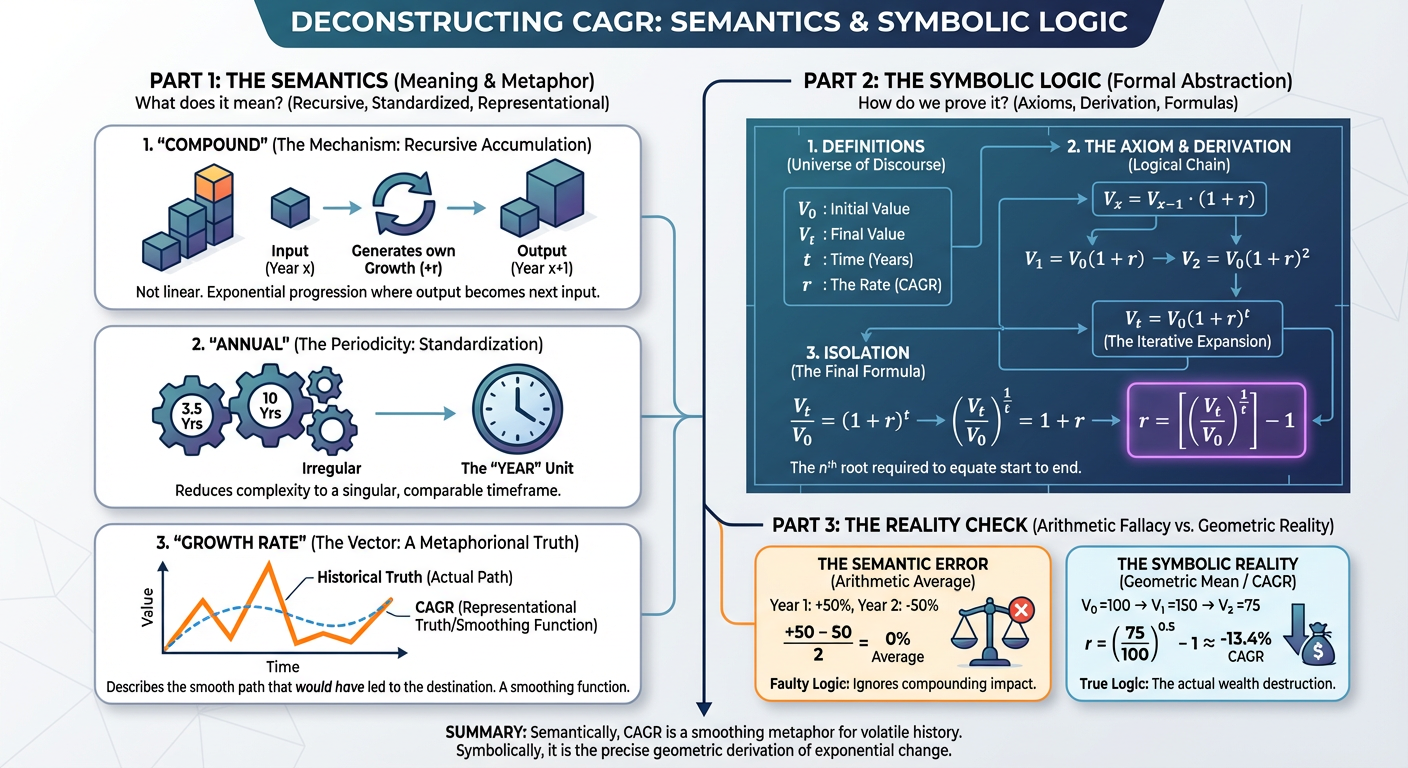
Here is an explanation of the Compound Annual Growth Rate (CAGR) deconstructed through Semantics (the study of meaning) and Symbolic Logic (the study of formal abstraction and reasoning).
$V_0$: Initial Value (at time 0)
Part 1: The Semantics of CAGR
Semantics asks: What does this concept mean definitionally, and what does it imply about reality?
We can break down the term Compound Annual Growth Rate into its semantic atomic units.
1. "Compound" (The Mechanism)
- Semantic Meaning: Recursive accumulation. It implies that the output of one iteration becomes the input of the next.
- Implication: This distinguishes CAGR from "Simple Interest." In a semantic sense, "Simple" implies linear progression, whereas "Compound" implies exponential progression. The growth generates its own growth.
2. "Annual" (The Periodicity)
- Semantic Meaning: Standardization. It converts specific, irregular timeframes (e.g., 3.5 years, 10 years) into a singular, comparable unit: the Year.
- Implication: This acts as a reducer of complexity, allowing distinct investments of varying lengths to be compared linguistically on equal footing.
3. "Growth Rate" (The Vector)
- Semantic Meaning: A representation of velocity and direction.
- The Semantic Shift: This is the most critical semantic nuance. CAGR is a representational truth, not a historical truth.
- Historical Truth: "The stock went up 20% in year one, down 10% in year two, and up 5% in year three." (This is jagged and volatile).
- Representational Truth (CAGR): "The stock grew smoothly at 4.1% every year."
- Conclusion: Semantically, CAGR is a metaphor. It describes a smooth path that would have led to the final destination, even though the actual path taken was different.
Part 2: The Symbolic Logic of CAGR
Symbolic Logic asks: How do we express the truth conditions of this concept using formal notation?
To explain CAGR logically, we must prove the relationship between the Beginning Value and the Ending Value over Time.
1. Definitions (The Universe of Discourse)
Let us define the variables in our logical system:
- $V_0$: Initial Value (at time 0)
- $V_t$: Final Value (at time $t$)
- $t$: The domain of time (number of years)
- $r$: The rate (CAGR)
2. The Axiom of Compounding
The fundamental logical premise of compounding is that the value at step $x$ is a function of the value at step $x-1$.
$$Vx = V{x-1} \cdot (1 + r)$$
3. The Logical Derivation
We want to find $r$ such that it satisfies the condition of moving $V_0$ to $V_t$.
Step A: Iterative Expansion By applying the axiom repeatedly for $t$ iterations, we construct the logical chain: $$V_1 = V_0(1+r)$$ $$V_2 = V_1(1+r) \rightarrow V_0(1+r)(1+r) \rightarrow V_0(1+r)^2$$ $$\therefore V_t = V_0(1+r)^t$$
Step B: Isolation of the Variable (Logical Equivalence) We must define $r$ in terms of Truth ($V_t$, $V_0$, and $t$). We act to isolate $r$ using algebraic logic.
- $\frac{V_t}{V_0} = (1+r)^t$ (Divide by $V_0$)
- $(\frac{V_t}{V_0})^{\frac{1}{t}} = 1+r$ (Raise both sides to the power of $\frac{1}{t}$)
- $(\frac{V_t}{V_0})^{\frac{1}{t}} - 1 = r$ (Subtract 1)
4. The Formal Predicate
We can express the definition of CAGR using Predicate Logic.
Let $C(r, V_0, V_t, t)$ be the statement "r is the CAGR of an asset starting at $V_0$ and ending at $V_t$ over time $t$."
$$C(r, V_0, V_t, t) \iff [V_t = V_0(1+r)^t] \land [t > 0] \land [V_0 > 0]$$
(Translation: $r$ is the CAGR if and only if applying $(1+r)$ to the initial value $t$ times results in the final value, assuming time and initial value are positive.)
Part 3: Semantic vs. Logical Error (The Arithmetic Fallacy)
To fully understand CAGR, one must look at the logical fallacy people commit when ignoring it.
The Scenario:
- Year 1: Valuation $+50\%$
- Year 2: Valuation $-50\%$
The Semantic Error (Arithmetic Average): A person might say, "I gained 50 and lost 50, so my average return is 0%."
- Logic: $\frac{+50 - 50}{2} = 0\%$
The Symbolic Reality (Geometric Mean/CAGR):
- $V_0 = 100$
- $V_1 = 150$ ($100 \times 1.5$)
- $V_2 = 75$ ($150 \times 0.5$)
- $V_t = 75$, $V_0 = 100$, $t = 2$
Using our symbolic logic derivation: $$r = (\frac{75}{100})^{\frac{1}{2}} - 1$$ $$r = (0.75)^{0.5} - 1$$ $$r \approx 0.866 - 1$$ $$r \approx -0.134$$
Conclusion: The CAGR is -13.4%.
Summary
- Semantically, CAGR is a smoothing function. It translates the chaotic language of "up and down" volatility into the linear language of "steady progress."
- Symbolically, CAGR is the n^th^ root of the total growth factor. It is the geometric derivation required to equate a starting value to an ending value across an exponential timeline.